Consumers and Producers

smart phone recording

Credit: Smartphone recording [id: 5531502] by Peggy_Marco under Pixabay License.

Jenkin’s participatory culture is an opportunity for participants to become producers, as well as consumers of content, through the avenues of new media creation. Students come together and work as a team to achieve a common goal but utilise the talents of team members. Students can engage in informal mentorship by passing on their expertise. More often than not, students will move between the roles of ‘expert’ and ‘novice’ throughout the creative process.

21st Century Skills

These skills will help prepare students today, for their future careers tomorrow. Participatory scenarios are useful in fostering these essential skills. Social skills will be essential for successful teamwork, and digital skills will support creativity and production. 21st century skills include:

  • Critical thinking
  • Creativity
  • Collaboration
  • Communication
  • Information literacy
  • ICT skills
  • Teamwork

New media is that which relies on connection and interaction, and is typically computer-related. New media provides many opportunities to foster self-expression, expand knowledge through personal interests and builds capabilities through new ways of reading and writing. YouTube, for example, provides users the opportunity to consume (watch) videos, but also produce (create and upload) videos. Social networking aspects of the site allow other users to comment, like, share, or add videos to their playlists.

Of particular interest on YouTube is the growing number of LEGO inspired video creations, most using the same stop motion techniques as recreated in The LEGO Movie. Stop Motion Animation is a simple activity, which provides teams an opportunity to make and create media in their vision, and under their control, about whatever meanings they want to portray to the world.

This is a really short clip I made with my Pick-A-Brick purchase at the LEGO® Store. A Stop Motion app would probably give a smoother result, as this was done very quickly, and very rustic! I simply took A LOT of photos (hundreds) on my iPad, imported them to Pinnacle Studio, set each picture to be a frame or so long, and boom! “Dancing Lego”.

“Dancing Lego” by MissE © 2020.
LEGO and the LEGO brick are trademarks of the LEGO Group. ©2020 The LEGO Group. All rights reserved.

Stop Motion Animation can allow students to get creative and work on developing lots of useful skills like teamwork, patience, perseverance, precision, storytelling and ICT skills. Film challenges could be directly linked to curriculum learning (extending or retelling a story, to explain concepts), or an opportunity for creative expression (free choice).

You could consider a school social media account to share students’ work through platforms like YouTube and Vimeo (providing your school, district and/or state allow it). Making connections, starting dialogues and receiving feedback from like-minded community members can enhance the participatory experience, and learning for students.

Credit: 6 FREE Stop Motion Apps iPhone iPad | LEGO Stop Motion Tips by Brickology. YouTube video.

This video review by Brickology demonstrates some stop motion apps that are currently available, along with some of the features that might be worth considering. These are, however, just a few of the many options available. Make sure you ‘try before you buy’, and are familiar with the application before considering its implementation into the classroom.

Final thought… Considerations for app purchases:

  • Accessibility: is it the whole app, or will further in-app purchases be necessary to access features and export footage?
  • Software: do you have the appropriate devices to run the software? Will you need to upgrade your software?
  • Content: will the app allow access to inappropriate content or allow students to make purchases?
  • Licences: do you have the right to install it on all devices, or just one? Can you get access to multiple licences?

School is for learning; it’s no place for gaming.

chess board

Credit: Chess board [id: 2489553] by stevepb under Pixabay License.


Play-based learning is an effective pedagogical approach, used by Reggio Emilia schools, and as a key principle of early childhood education. The scope of the Early Years Learning Framework promotes play-based opportunities, whereas the restrictive Australian Curriculum impedes it. Add to that political pressure to attain good NAPLAN results, and play disappears from schools.

And yet, play is the natural learning tool of children. So, why does it end at preschool?

Why include gaming in schools?

Gaming, table-top or computer-based, is a great way to stimulate thinking, build relationships, teach patience and teamwork, and even extend vocabulary. Having fun, passing time, de-stressing and keeping active were some of the reasons 67% of Australians play video games, according to the Digital Australia Report.

There are two types of gaming: table-top gaming which requires a table (board games, cards games, fantasy role-play, construction play), and video/computer games which are played on electronic devices, either on or offline. Popular culture texts can be incorporated into both:

  • Table-top: Dungeons & Dragons, The Magic Gathering, LEGO®
  • Computer: Minecraft™, Pokemon Go, CandyCrush

All gaming needs to be situation appropriate. Computer games have rating classifications, just like films, and board games display age guides on packaging. Review games before including for appropriateness, skill level, stereotyping, etc.

What should I be aware of when introducing gaming?

  • Attitudes – many consider play a waste of time, but it helps social, emotional and critical thinking development, essential for academic learning.
  • Competitiveness – healthy competition teaches fair play and resilience, but the drive to win can take over.
  • Time – breaks are short, so consider experiences that can be easily interrupted
  • Cost – initial purchase, replenishment, licences, upgrades

What benefits will I see from introducing gaming?

Play is an informal learning opportunity that allows students to work on their personal growth. Play will foster:

You didn’t mention LEGO® yet…

True! LEGO is a great gaming introduction. The bricks afford students as little, or as much, game play as necessary, and interruptions are not detrimental (store unfinished builds until next time). Competition is not inherent, although authentic, learner led challenges to see who can build the tallest tower may arise. It can be costly – buy large classic sets from Kmart!

Librarian Nerd Alert: Consider incorporating LEGO texts (fiction and non-fiction) for double benefits – club users broaden their interests, and library users discover the LEGO club!

LEGO Club session suggestions:

  • Free play (photograph builds before dismantling)
  • Problem-based challenges
  • Story extensions
  • Robotics and Coding (using LEGO® Boost, LEGO® MINDSTORMS® or LEGO® WeDo 2.0)

How have you used LEGO® in a fun and creative way?

Rebuilding the World

Rebuilding the World

In 2019, LEGO® launched a new campaign – their first in decades, which was aptly named ‘Rebuild the World’. It resonates with LEGO enthusiasts, and is informative to those who are not familiar with LEGO® (do any exist?!). The almost 2-minute clip, however, is not what you would expect to see, but plays cleverly with many aspects for the LEGO system.

Credit: LEGO Rebuild the World by LEGO. YouTube video.
LEGO, the LEGO brick and LEGO minifigures are a trademark of the LEGO Group. ©2019 The LEGO Group.

No text can ever be unique. Bakhtin (as cited in, Allan, 2012) argues authors are influenced by their own biased social and cultural experiences and practices. Barthes (as cited in, Allen, 2011) further acknowledges the same is true of readers meaning an author’s message is always altered. Readers bring unique textual awareness to decoding, which prompts intertextual connotations unintended by the author. Although potentially unintentional, I made intertextual inferences between the advert and The LEGO Movie because of my knowledge:

The LEGO Movie (2014) uses animation for storytelling until the climax of the film, where it switches to live action. Audiences discover the animated action is the result of the child’s imaginative play. The advert begins with live action (and CGI), until the climax, where the characters and townscape morph into actual LEGO. Again, the action is the result of a child’s imaginative play with the LEGO bricks.

As a reader, my inferred intertextual knowledge devised an implied intertextuality based on style similarities, achieved through imitation and adaptation, or reinterpreting the movie – Hutcheon, 2012. Did you spot the similarities previously? Or only now you have been influenced by this text, affording you your own intertextual relationship play between this blog, the advert and movie?

A deliberate attempt to associate the advert with real-world LEGO was made through direct reference to the characters’ actions, and LEGO minifigure characteristics. For example, people bend at the waist, have rapidly changing hairstyles, fully rotating heads, and costumes with printed details. Piece elements, like oversized cups also appear, along with whole LEGO sets.

Similar to ‘Easter Eggs’ in digital games, these obvious, and not so obvious, elements are appreciated by those with suitable intertextual knowledge. The viewing of those who are unfamiliar, however, is not negatively impacted.

Given the campaign’s theme, you would expect live action scenes to be representational of  ‘rebuilt’ LEGO creations, featuring new creations or adaptations, but instead see many pre-existing sets included. It could be argued that their inclusion is counterintuitive to the campaign. So why include them, if not to deliberately allude to the rich and diverse history of LEGO products?

Either way, the sets and elements are there, and it is great fun trying to spot them! So, here, in no order, is a list of sets I have managed to spot so far:

  • Volkswagen Camper Van
  • Big Ben
  • Detective’s Office
  • Pink Car (from Diner) Note: the licence plate is actually for set 60138!
  • Harley Davidson
  • City Fire Brigade
  • City Police Force
  • Fabuland Characters
  • Lighthouse
  • Build-A-Duck
  • Mini Cooper (different colour)
  • Volkswagen Beetle (different colour)

I am sure there are still ones I have missed. Did you manage to spot all the ones I did? What else did you find?

Wait, what? You think a kid’s toy is popular culture?

boy playing with car

Credit: Boy playing [id: 286232] by White77. Image edited by MissE. Pixabay License.

Yes. And no. Depending. Most are commodities, merchandise crossovers for other popular movie/television franchises. They sell because of association, not because they are iconic. Generally toys do not influence culture; they are influenced by culture and the prevailing social norms. Some toys become iconic – Barbie, GI Joe, Rubrik’s Cube – but none more so than LEGO®.

Credit: The LEGO Story – How it all started by LEGO. YouTube video.
LEGO is a trademark of the LEGO Group. ©2012 The LEGO Group.

The LEGO Group came from humble beginnings, originally producing wooden toys, before diversifying into the famous plastic bricks. The family business philosophy was to only deliver the highest quality products, something that still remains today. Current quality measures mean roughly only 18 pieces in every million are discarded because of defects, making damaged pieces extremely rare. And because the production molds are accurate to within 0.002mm, LEGO bricks manufactured in 1958 still fit perfectly with those made last week!

From those humble beginnings to mass popular culture presence

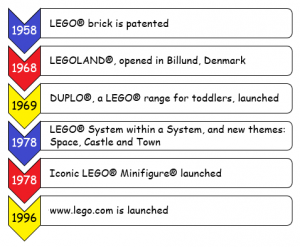
timeline

Credit: Company highlights timeline. Created by MissE. 2020. Based on information from The LEGO Group.

The LEGO Group have always striven to diversify, and despite growing popularity with tie-in products in the 80s and 90s (Wolf, 2015), they focused on generic socially reflective in-house themes (e.g. Town, Space). In 1999, however, after a period of financial uncertainty, The LEGO Group partnered with Star Wars™ to create the first licensed sets. Now sets had the capability of facilitating adaptations through play, extending imaginative play (free play vs set-restrictive structured play is an argument for another day), and allowing the development of transmedia narratives between the original licensed texts and children’s play worlds.

LEGO®, meanwhile, harnessed multi-modality to deliver transmedia narratives across multiple channels to create unique storytelling-play experiences about their own fictional worlds. Television series based on LEGO® Friends and LEGO® NINJAGO® help flesh out the play universe and character development. The LEGO Movie (2014) and The LEGO® NINJAGO® Movie (2017) served as new pathways into the LEGO® and NINJAGO® worlds, for children and adults, and inspired entire new movie-based playsets. Meanwhile, the international hit reality television series LEGO Masters added an element of reality to the LEGO universe.

Crossman (2019) suggests that popular culture is dependent on cultural products like “music, art, literature, fashion, dance, film, cyberculture, television and radio”. LEGO® has influenced them all.

  • Literature: Booktopia shows 700+ titles available for purchase; fiction extending the play universes, non-fiction extending building skills.
  • Fashion: LEGO® partnered with adidas to create the ZX 8000 trainer, and Levi’s to create an exclusive clothing range.
  • 2021: Children do LEGO building; adults do IKEA building. Put them together and what do you get? The BYGGLEK, a unique play-and-store system featuring LEGO bricks.
  • Art: LEGO is an art movement, further blurring the lines of commercialism and user authenticity with ‘high culture’ artwork exhibitions. The Art of the Brick uses LEGO bricks as medium, whilst fans are creating mosaic pictures. The LEGO Group recently announced its own brick-art range, LEGO® Art.
  • Architecture: Yup! Martin Heuwold (with permission from The LEGO Group and town council) painted the Lego-Brücke (Lego-Bridge) in Wuppertal, Germany to resemble giant LEGO bricks!
lego bridge

Credit: Lego-Brücke in Wuppertal, Germany, by Atamari, CC BY-SA 3.0, via Wikimedia Commons

What makes LEGO so popular and transcending?

Its simplicity and possibility.

Six 2×4 bricks can be joined in 915,103,765 different ways – creation is limitless. Quality and precision engineering ensure versatility. They are almost indestructible – just ask anyone who’s stepped on it, barefoot, at 3am. And, it delivers what it promises – an easy-to-use building system. It fosters creative thinking, spatial awareness, and engineering experiences, all whilst acting as a form of relaxation for all ages (although challenging builds are known to increase frustration).

It is a medium that can be utilised anywhere, for any purpose, by anyone.

It embraces a post-modern view of popular culture by blurring the lines between the ‘authentic’ (built by the people) and ‘commercial’ (manufactured for the people). LEGO, as popular culture, affords us the opportunity to embrace the content through play, alter it through adaptation or alternative methodologies, or reject or reimagine it through MOCs (my own creations) and imaginative play (Storey, 2018).

Whether you determine popular culture as dependent on the popularity of the masses, or post-modern blurriness, either way, this kids toy, this little plastic brick, is popular culture.

Welcome to the Blog!

Source: blog [id:2355684] by Wokandapix under Pixabay License.

Hello and welcome to my new blog!

Feel free to follow my ramblings on how block-based game play systems, like LEGO® and Minecraft™, can provide engaging collaborative experiences for children, develop their imagination and creativity, and support their formal education and learning.

I don’t claim to be an expert in any way, shape or form. My time in the teaching field is limited, but I have some ideas to share. Whilst they may not be that exciting, useful, or even practical, if it sparks even the slightest glimmer of hope in the eyes of a front-line teacher, then it was worth it!

Let’s see if we can make a difference to students, block by block.